
For DTC and ecommerce brands tired of guessing what to shoot next
Your next winner shouldn't be an accident.
A complete creative system, built in ten days.
- The research on your buyer
- Five ready-to-shoot scripts
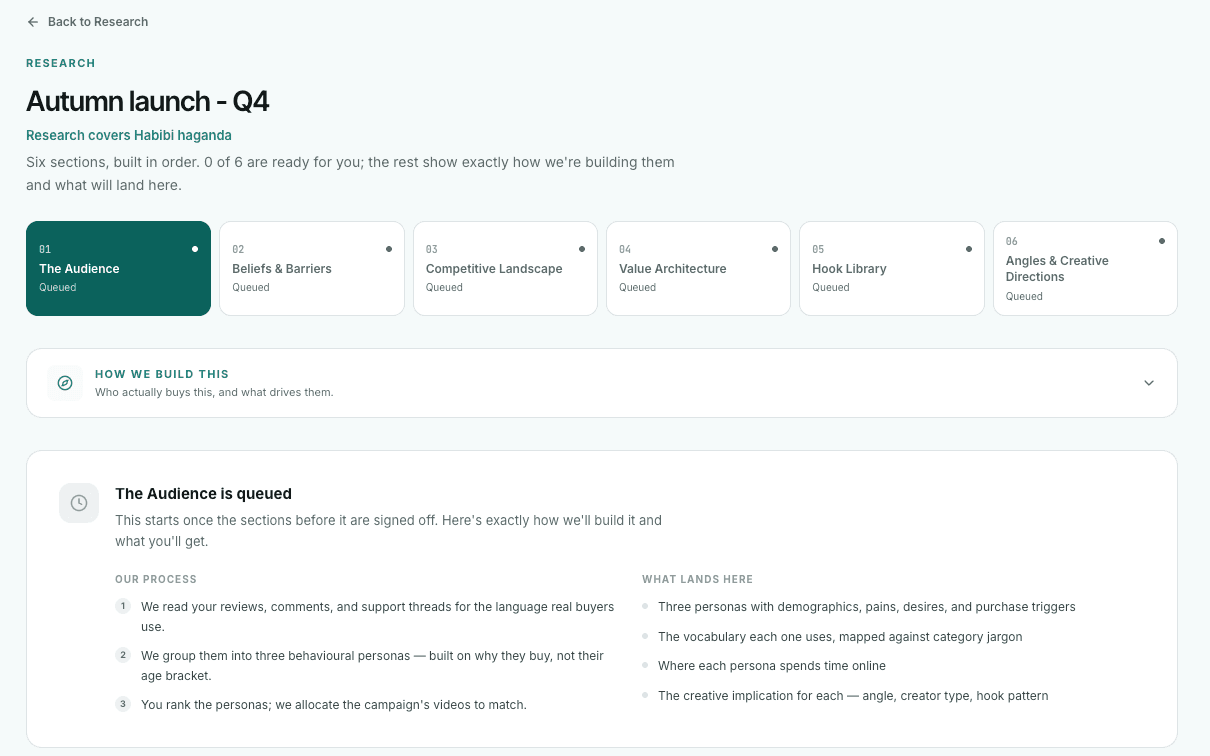
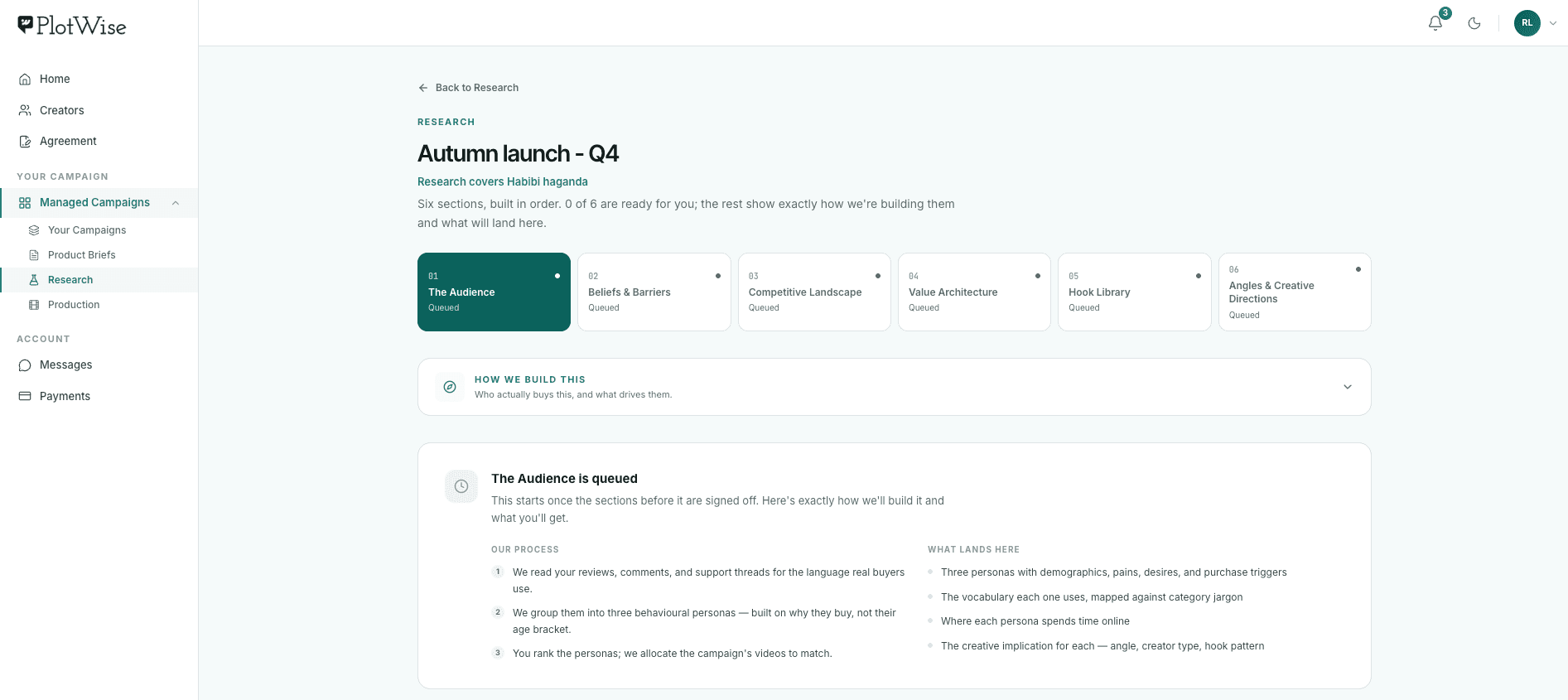
- A purpose-built workspace where your whole creative operation runs, from brief to creator to finished ad
Most agencies hand you files. This is where your creative operation actually runs, and it stays yours.
We map what your buyer actually believes, what's stopping them from buying, and the one argument your competitors aren't making. Then we turn it into scripts you can shoot next week, and the workspace where your creators, your editor and your media buyer all work from the same angles.
No more briefing on instinct. No more winners you can't repeat.
$1,500 · One payment · Delivered in ten working days
Don't like it? Full refund on day five.
You see half the build before you're committed. If it isn't what you wanted, say so on that call and we return every dollar. No reasons needed.
The real reason ads stall
Nineteen out of twenty ads never work. Yours included.
That isn't your team failing. Meta analysed $1.3 billion in ad spend across 550,000 ads last year: only 5 to 8% ever become real winners, and half never get meaningful spend at all. The question isn't why most of your ads die. It's what you learn from the ones that don't.
One in twenty. Next month you get to guess again.
You can't repeat your winners.
One video takes off. You tell the creator, "more like that one." The next batch flops, because nobody knows which part was the that. The hook? The face? The angle? You bought a win. You didn't buy the reason.
You don't learn from your losers.
The eight that died cost exactly as much to make as the two that won. Nobody studies them. They get deleted and replaced with fresh guesses. Same coin, new flip.
So you're playing a numbers game with no memory.
New batch, new invoice, same blindfold. Your ad spend compounds month over month. Your knowledge doesn't. In a game where 19 in 20 lose, the only edge is knowing why the twentieth won, and nobody's writing that down.
At $5K a month, guessing is a tax you can afford. At $50K, it's the biggest line item on your P&L.
Q4 raises everyone's spend. It doesn't raise anyone's answers.
Prove it to yourself
Think you're not guessing? Ten questions.
Most founders get four. Tick the ones you can answer right now, out loud, without opening a dashboard.
You answered 0 of 10.
Every blank is a decision your next creative is making without you.
The build answers all ten. For your brand, in writing, in ten days.
Book a fit callRefundable in full on day five. You see half the build before you commit.
What we actually do
We find the one thing your buyer needs to hear. Then we hand you the system that says it.
Six steps. Ten days. Here's exactly what happens.
Your creative is your targeting now.
Meta stopped letting you choose your audience in any meaningful way. Broad targeting won, interest stacking died, and the algorithm now reads your ad to decide who sees it. Open with the wrong belief and you get shown to the wrong people, no matter how you set up the campaign.
Which means the angle isn't the thing that comes before the targeting. It is the targeting.
That's what the six steps below are actually building.
We find out what your buyer already believes.
If you have reviews, DMs and support tickets, we start there, because your buyer has already told you what they think in their own words. If you're launching, or you're early, we go where they talk instead: competitor reviews, forums, comment sections, the one-star reviews of the product they tried before yours. Either way, we come back with their language, not yours.
We find the reason they don't buy.
Every category has one belief that blocks the sale.
We find yours, and the fear sitting under it. That's the wall your ads keep bouncing off.
We map the competitors who matter.
Not fifty. The handful you're actually losing customers to, plus whoever's spending hardest in your category. We pull their live and retired ads and write down what each one is claiming, so you can see the whole conversation on one page and spot the claims nobody has taken.
We pick the argument only you can win.
There's always one. The thing your product can say that your competitors can't, that also breaks the wall from step 2. This is the whole job. Everything before it was finding it. Everything after is saying it well.
Five angles beats fifty variations.
Most brands respond to a slow month by producing more. Same message, new creator, different background, ten more files. The algorithm sees ten versions of one idea and learns one thing.
Five genuinely different arguments teach it five things. That's why we cap this at five and make each one count, instead of handing you a folder.
We write two hooks for every ad.
Same message, two completely different openings. Because when you test one hook you learn nothing. When you test two, you find out which door your buyer walks through.
You get five scripts, tagged and ready to shoot.
Each one carries the angle it came from, the belief it's attacking and the funnel stage it's built for, so you and your media buyer can decide what to run and when. Hand them to any creator.
It all lives in your workspace, not a folder.
The research, the angles and the scripts land inside the platform, where your team works from them. Generate a link, send it to any creator you use, and their uploads come back against the right angle. Three months included.
Ten days from now, you stop briefing creators on vibes.
The deliverables
Here's everything that hits your inbox on day ten.
Built for your brand specifically. Nothing templated, nothing recycled from another client. And most of it isn't ads.
The research document.
Your buyer, in their words. The belief blocking the sale. The fear underneath it. What your competitors are claiming and where the gaps are. The argument only you can win. This is the part you keep forever, and the part every future creative decision gets made from.
Five scripts, ready to shoot.
Each one built on a documented angle, tagged with the belief it attacks and the funnel stage it's for. Hand them to any creator you already work with, or use ours.
Ten hooks. Two per script.
Same message, opposite openings. This is how you find out which door your buyer walks through, and it's the difference between testing and guessing.
The workspace, for three months.
Where all of it lives. Your team works from it, and you can send a link to any creator so their uploads land against the right angle instead of in a Drive folder nobody can navigate.
Delivered in ten working days
$1,500
One payment
A creative strategist costs $6K to $8K a month and you'd manage them. An agency retainer starts at $5K and locks you in for three. This is the research layer, done once, done properly, and it's yours whether you ever work with us again.
You see half the build before you're committed.
On day five, three of the six sections land: your audience, the beliefs blocking the sale, and the competitive map. If you don't want to continue, say so on that call and we refund the full $1,500. No reasons needed. Every finding is sourced, so you can check the thinking behind any claim before you decide.
From the first builds
What brands say after they've read it.
We asked everyone the same three questions: what the research showed them about their buyer, what they did with the scripts, and what they'd tell another founder. Their answers, unedited.
The competitive map was the part that stung. Two of our three main claims were already being made, louder, by people outspending us. We stopped saying them the week we read it.
First brief I've sent a creator without apologising for it.
We had eleven months of ad data and no explanation for any of it. What came back read like someone had gone through our account and written down the reasons out loud. Two of the five scripts are still running. The one we thought was weakest is our best performer on cold traffic, which tells you how good our instincts were.
The belief blocking our sale wasn't price. It was that nobody thought a product like ours could work at home. We'd spent a year arguing about price.
I'd tell another founder the honest thing: it doesn't feel like buying ads. It feels like being handed the argument, then finding out how little of it you'd written down. Our editor works off the same document our buyer does now.
Ten days, and the day-five call was the one that mattered. We could see where it was going before we were committed.
We shot all five with the same creator in one afternoon. Because each script said what it was attacking, she stopped asking us for references and just performed the argument. The two hooks per script is the bit I'd pay for on its own.
Our buyer's own words were harsher and better than anything in our brand guidelines. We use three of their sentences verbatim.
We've kept the document open in every creative meeting since. It has outlived two agencies and one media buyer, and it's still the reason we can explain why a winner won.
Every one of these took the same ten days yours will.
Day 11 onward
The build stops on day ten. The system doesn't.
Everything we make lands inside your workspace, and you keep it running for 90 days. Here's what your team can actually do with it.
Brief creators without briefing creators.
Generate a link, send it to any creator you work with. They see the script, the angle it came from, the hook variants, and what the video is supposed to do. No PDF attachments, no explaining the strategy over WhatsApp, no version three of a doc nobody can find.
Uploads land where they belong.
When a creator submits, the file attaches to the angle it was shot for. Six weeks later, when you're looking at what performed, you're not staring at a Drive folder called "final_v2_USE THIS." You're looking at a video with its belief, its hook type and its funnel stage still attached to it.
Your research stops being a document.
The six sections stay live. When you learn something from a test, it goes back into the angle it came from. The next round of creative starts from what you know now, not from what you knew in September.
Everyone works from the same page.
Your media buyer, your editor, your creators and you are all looking at the same angles and the same reasoning. Nobody is briefing from memory.
This is the part that compounds. Ten days builds it. The next 90 is where it starts paying you back.
Before you book
We've talked more brands out of this than into it.
Because research only works when the problem is actually creative. Half the time it isn't, and we'll tell you that on the call. Here's how to check before you book.
This is built for you if:
Seven signals. Most brands that fit recognise themselves in three.
You're spending on paid social and creative is the thing holding you back, not budget or product.
You've had a winner you couldn't repeat, and it still bothers you.
You have creators, or can get them, and what's missing is what to tell them.
You're about to spend more this quarter than last, and you'd rather not spend it the same way.
You've paid an agency for strategy before and got a deck you never used.
Your old targeting playbook stopped working and you're not sure what replaced it.
You're launching your first store and would rather work out the angles now than find them at $10K in.
Starting from research is cheaper than starting from guesses.
Don't book if:
Any one of these is a no from us on the call.
You're getting traffic but no sales at all.
Read this one carefully. If you're running ads and getting almost nothing, the problem is usually not your creative. It's the site, the offer, the trust signals or the product. Targeted traffic converts at 1 to 2%, untargeted at a quarter of that, and no amount of better angles fixes a page people don't trust. Fix that first. We'd rather tell you now than take your money and watch it not work.
You need videos, not answers.
If your creative is working and you just need more of it, buy production. This won't help you and we'll say so on the call.
You don't have a product yet.
If you're still choosing between ideas, there's nothing for the research to attach to. Come back when you've picked one.
You want it in a week.
Ten working days is the floor. The research is the product, and rushing it defeats the point.
You want a guarantee on performance.
Nobody can honestly promise you a ROAS number from research. If that's the deal you're looking for, someone will offer it to you, and they'll be lying.
If the first list sounds like you, the call takes twenty minutes.
The rest of it
Everything people ask before they book.
Anything else, ask on the call. It's twenty minutes and there's no pitch at the end of it.
Ten days from now, you'll know what to shoot next.
The full research build on your brand. Five scripts, ten hooks, tagged and ready for any creator. Your workspace for 90 days. One payment of $1,500, and you see half of it on day five before you're committed.
Still not sure? You see half the build on day five and can walk away with a full refund. No reasons needed.
Builds starting this week deliver before Q4 spend ramps. Builds starting in October arrive after you've already made the decisions.